July 19, 2026
Pentecost 8 / Proper 11, Year A
The Rev. Dr. Elaine Ellis Thomas
St. John’s Episcopal Church, Essex, CT
Genesis 28:10-19 ~ Psalm 139:1-11, 22-23 ~ Romans 8:12-25 ~ Matthew 13:24-30, 36-43
In 2018, Kate Bowler, a professor of Religious History at Duke Divinity School, wrote an essay published in the New York Times with the title “Death, the Prosperity Gospel, and Me.”[1] Bowler’s research up to then focused principally on the brand of evangelicalism that emphasizes that good things come to faithful people, that God wants only the best for true believers (including, by the way, hefty bank accounts and big houses), and that, if you suffer illness or poverty or some other misery, you just need to try harder, to believe more fervently, and to dig a bit deeper in your wallet when the collection plate comes around.
Bowler thought that she stood apart as an observer of the Prosperity Gospel, but when, at the age of 35 she was diagnosed with Stage IV colon cancer, her immediate thoughts were, “why me? I’ve been good. Why has God done this tome – I have a newborn son!”
Her essay generated a tidal wave of response and ultimately led her to write her bestselling book, “Everything Happens for a Reason and Other Lies I’ve Loved.” The title comes from an encounter shortly after her diagnosis when a neighbor came the door, and, when Bowler’s husband answered, this visitor – unable to find a better thing to say – said to him, “well, I guess everything happens for a reason,” to which he responded, “I’d love to hear it…I’d love to hear the reason my wife is dying.”[2]
In her book, she wrote about phrases like that – everything happens for a reason, or God won’t give you more than you can handle, or God must have needed another angel. None of this is biblical, and in our feeble attempts to try to explain or control everything rather than believe that there is so much out of our control and beyond our ability to explain, we commit the gravest error of all which is to think that an all-loving, all-merciful God wants to cause us harm, wants to see us suffer, wills calamity on us.
Some things in this life are just a weird mutation of cells or expecting that people on the highway are paying attention or that our very human bodies eventually break down and stop working altogether.
Jesus answered the disciples, “An enemy has done this” (Matthew 13:28). God did not plant those weeds to teach the farmer a little fortitude and perseverance through suffering. No, an enemy did this wicked deed.
Now, we don’t have to believe in a devil running around with horns and a pointed tail to know that evil persists in the world. Yes, sometimes there is a randomness in catastrophe, but things like famine, deaths from preventable diseases, raging storms caused by an overheated planet – all of these are created, perpetuated, or allowed to flourish by humans. Maybe people don’t think that they are evil, but through action or inaction, evil is the result.
God does not will that children die or that the poor lack access to clean water or medical care or that storms cause floods that wash away homes and people and animals without regard for how good of a Christian they are.
The enemy has done this.
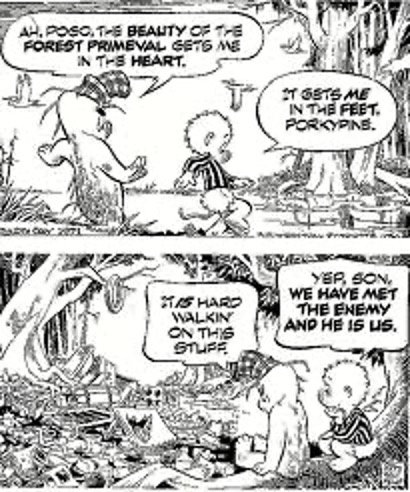
And, in the words of that old comic strip, Pogo says, “we have met the enemy, and he is us.”
In the 8th chapter of his Letter to the Romans, the Apostle Paul has been bemoaning the unseen forces that prevent him from doing the good he wants to do, and we are just about to the end of that chapter when he looks forward in hope, knowing that it is only as heirs with Christ that we obtain salvation. We can’t think our way or work good deeds our way or Prosperity Gospel our way into heaven. It is only because we have a God who came as one of us, who died a criminal’s death to show us that evil does not triumph, that we and all creation are reconciled to God.
And because we are worshipping outside next week, and I’m not the preacher, I’m going to go ahead and give you Paul’s money-shot:
What then are we to say about these things? If God is for us, who is against us? He who did not withhold his own Son, but gave him up for all of us, will he not with him also give us everything else? Who will bring any charge against God’s elect? It is God who justifies. Who is to condemn? It is Christ Jesus, who died, yes, who was raised, who is at the right hand of God, who indeed intercedes for us. Who will separate us from the love of Christ? Will hardship, or distress, or persecution, or famine, or nakedness, or peril, or sword?…No, in all these things we are more than conquerors through him who loved us. For I am convinced that neither death, nor life, nor angels, nor rulers, nor things present, nor things to come, nor powers, nor height, nor depth, nor anything else in all creation, will be able to separate us from the love of God in Christ Jesus our Lord. (Romans 8:31-35, 37-39)
We have been following the saga of Jacob as we make our way through Genesis, and if you haven’t figured it out by now, Jacob was not a very nice person. He was a schemer, a trickster, and thief, and a cheat. And what did God do with him? God made him the father of the Twelve Tribes of Israel. God did not give up on old Jacob any more than God gives up on any of us. And every now and then, maybe we, too, can get a glimpse of the House of God – beth-El – just as Jacob did.
So, what are we to do with this parable of the weeds and the wheat? Do we just let evil run rampant? Do we not confront wickedness when we encounter it?
I’m not sure those are the questions Jesus is answering here. He is talking in images about the Kingdom of Heaven, the Reign of God. Jesus knows that we will set ourselves up as judge, jury, and executioner if we are left to our own devices. Who’s in and who’s out of God’s kingdom is up to God. We don’t have the good sense to recognize the rationalizations and self-justifications we make about our own behaviors much less someone else’s.
Yes, we should protect the innocent and marginalized from those whose actions cause devastation; we should protest the unjust killing of immigrants on their way to work, but the ultimate fate of the perpetrators is God’s alone. God’s judgment will come, not just for those people, but for us, as well. But even judgment is not the last word, because God’s love and mercy will always bat last, and nothing in all creation will separate us from that.
[1] February 13, 2026, New York Times
[2] Ibid.